
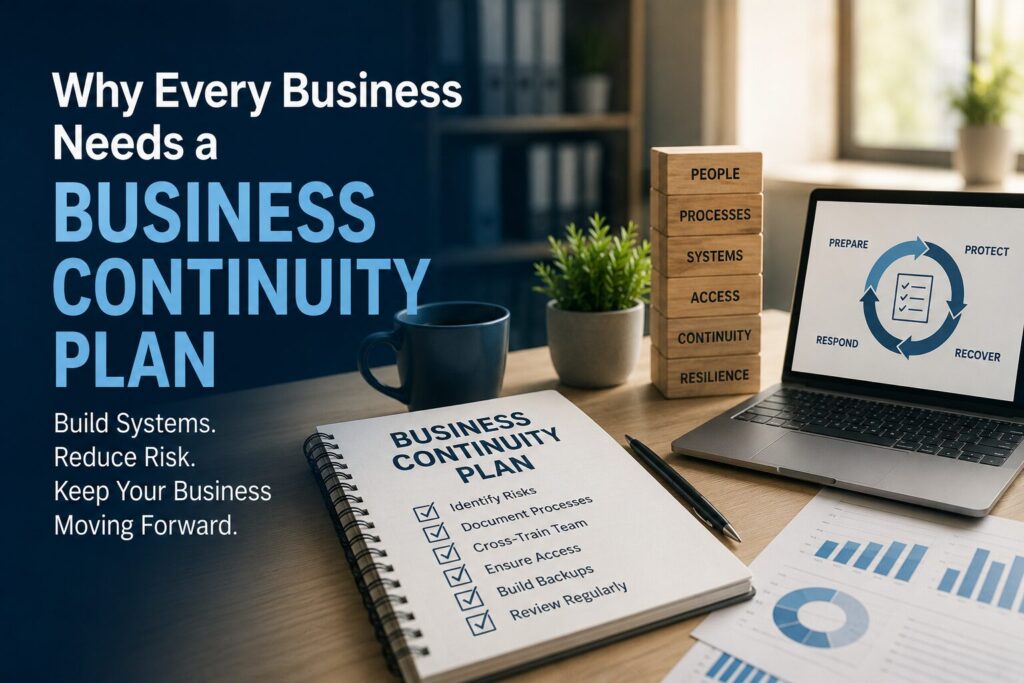
Business Continuity Planning for Small Businesses
Business continuity planning is essential for businesses that want to protect operations from unexpected disruptions. Whether a key employee resigns, takes extended leave, or becomes unavailable due to an emergency, a strong business continuity planning strategy helps ensure payroll, compliance, HR functions, and daily operations continue without interruption..
Business continuity planning is one of the most important strategies for protecting your company from unexpected disruptions. Whether a key employee resigns, takes extended leave, experiences a medical emergency, or suddenly becomes unavailable, your ability to continue operating depends on the systems you have in place.
Your most reliable employee just resigned.
Or perhaps they’re in the hospital. Maybe they’re dealing with a family emergency and can’t return to work for the foreseeable future.
Whatever the reason, they’re gone.
Then reality hits: they were the only person who knew how critical parts of your business actually worked.
They managed payroll. They handled employee records. They maintained vendor relationships. They tracked compliance deadlines. They controlled access to important systems and accounts.
Now nobody knows exactly what to do next.
This is precisely why business continuity planning matters.
Many small and midsize businesses assume business continuity planning is only necessary for large corporations preparing for natural disasters or major emergencies. In reality, one of the biggest operational risks comes from something much more common: losing access to a key employee.
Without a business continuity plan, a single resignation, illness, or unexpected absence can disrupt payroll, delay critical tasks, create compliance issues, and negatively impact customer service. Effective business continuity planning helps organizations prepare for these situations before they become expensive problems.

What Is Business Continuity Planning?
Business continuity planning is the process of creating systems, procedures, and backup plans that allow a business to continue operating during unexpected disruptions.
A well-designed business continuity plan ensures that critical functions remain operational even when key employees, technology systems, vendors, or facilities become unavailable.
The objective is simple: keep your business running regardless of the challenge.
Why Business Continuity Planning Matters for Small Businesses
Small businesses often operate with lean teams and limited resources. As a result, critical knowledge frequently becomes concentrated in the hands of a few trusted employees.
While this may seem efficient, it creates risk.
If one employee becomes responsible for payroll, HR administration, compliance reporting, vendor communication, or system management, their absence can immediately affect daily operations.
That’s where business continuity planning becomes essential.
Rather than depending on one individual, continuity planning creates processes and backup systems that allow work to continue smoothly when staffing disruptions occur.
Common examples include:
- One employee manages payroll processing
- One employee controls access to financial systems
- One employee handles employee records and HR documentation
- One employee oversees vendor communications
- One employee understands key operational procedures
- One employee manages regulatory filings and compliance deadlines
Everything appears to work perfectly until that person is no longer available.
Without proper business continuity planning, even a temporary absence can create operational disruption that affects the entire organization.

The Hidden Risks of Relying on One Employee
Trusting employees is essential.
Building your business around a single employee is not.
When critical knowledge exists only in one person’s head, your business becomes vulnerable to circumstances outside anyone’s control.
Employees may resign unexpectedly. Medical emergencies can happen without warning. Family obligations can require immediate leave. Retirement, relocation, or career changes can create sudden knowledge gaps.
None of these situations are unusual.
What turns them into a business crisis is the absence of a continuity strategy.
Organizations that fail to invest in business continuity planning often discover their weaknesses only after disruption has already occurred.
By then, the damage is already underway.
What Happens When Critical Business Knowledge Disappears?
The consequences of poor business continuity planning extend far beyond inconvenience.
Payroll Disruptions
Employees rely on accurate and timely compensation.
If the individual responsible for payroll becomes unavailable and no backup process exists, payroll errors and delays can occur quickly. This can damage employee trust, impact morale, and create legal or compliance concerns.
Compliance Risks
Missing tax filings, incomplete employee documentation, and overlooked reporting requirements can expose businesses to regulatory penalties and legal liabilities.
Many organizations don’t realize how dependent they are on a single employee for compliance management until deadlines begin slipping.
Operational Delays
When processes aren’t documented and responsibilities aren’t shared, employees don’t know who has authority, access, or knowledge to move work forward.
Approvals stall. Questions go unanswered. Productivity declines.
Customer Service Challenges
Operational confusion often impacts customers first.
Missed communications, delayed responses, and service interruptions can damage relationships and negatively affect customer retention.
Financial Losses
Business interruptions carry real financial consequences.
Lost revenue, emergency staffing costs, overtime expenses, compliance penalties, and customer churn can quickly become far more expensive than investing in continuity planning from the start.
How Business Continuity Planning Protects Payroll, HR, and Compliance
The strongest businesses are not built around individuals.
They’re built around systems.
Business continuity planning creates structure that allows organizations to operate effectively regardless of personnel changes.
A comprehensive continuity strategy typically includes:
Documented Procedures
Every critical process should be documented through clear, accessible standard operating procedures (SOPs).
Employees should never have to rely solely on verbal instructions or institutional memory.
Shared Access Controls
Essential systems, software platforms, and operational tools should be accessible to multiple authorized personnel through secure access management practices.
No single employee should be the sole gatekeeper of critical business information.
Cross-Training Programs
Key functions should have designated backups who are trained and capable of maintaining operations when primary personnel are unavailable.
Cross-training significantly reduces operational risk.
Payroll Continuity Plans
Businesses should establish payroll backup procedures and partnerships that ensure employees continue to be paid accurately and on time regardless of staffing disruptions.
HR Continuity Systems
Employee records, onboarding procedures, benefits administration, and compliance documentation should be organized within systems that support continuity and accessibility.
Compliance Safeguards
Automated reminders, documented schedules, and shared accountability help ensure important deadlines are not missed when staffing changes occur.
Why Business Continuity Planning Is a Leadership Responsibility
Some business owners believe continuity planning can wait until the company grows larger.
Unfortunately, smaller businesses often face the greatest risk.
Large organizations typically have multiple layers of management, documented processes, and built-in redundancy. Small businesses frequently operate with fewer resources and greater dependence on individual employees.
As a result, a single absence can have a much larger impact.
Business continuity planning is not about expecting failure.
It’s about responsible leadership.
Leaders who prioritize continuity planning create stronger organizations, protect their employees, improve operational resilience, and position their businesses for long-term success.
A 6-Step Business Continuity Planning Framework for Small Businesses
Creating a business continuity plan doesn’t have to be overwhelming.
Start with these six practical steps.
Step 1: Identify Critical Dependencies
Determine which business functions currently rely on a single employee.
Focus on payroll, HR administration, compliance, finance, technology access, customer service, and vendor management.
Step 2: Document Key Processes
Create written procedures for all critical business functions.
Documentation should be clear, organized, and accessible to authorized team members.
Step 3: Cross-Train Employees
Ensure at least one backup employee understands every mission-critical process.
Cross-training strengthens resilience and reduces operational risk.
Step 4: Centralize System Access
Implement secure password management and access controls that allow approved personnel to access essential systems when needed.
Step 5: Establish Payroll and HR Continuity Support
Partner with trusted payroll providers or Professional Employer Organizations (PEOs) that can help maintain continuity during staffing disruptions.
Step 6: Review and Update Regularly
Business continuity planning is an ongoing process.
Review procedures, dependencies, staffing structures, and operational risks quarterly to ensure your plan remains effective.
The One Question Every Business Owner Should Ask
If your most important employee couldn’t come to work tomorrow, would your business continue operating effectively?
If you’re uncertain, that’s your answer.
Uncertainty reveals a continuity gap.
The longer those gaps remain unresolved, the greater the risk to your business operations, employees, customers, and growth objectives.

How Fortune Business Consulting Supports Business Continuity Planning
At Fortune Business Consulting, we help small and midsize businesses identify operational vulnerabilities and build systems that support long-term resilience.
Through payroll solutions, HR administration, compliance support, workforce management services, workers’ compensation guidance, and PEO partnerships, we help organizations reduce operational risk and strengthen business continuity.
Our goal is simple: your business should continue moving forward even when unexpected challenges arise.
Because no company should be one resignation, one illness, or one absence away from operational disruption.
Final Thoughts
People are one of your greatest assets. However, your business should never depend entirely on a single person to keep operations running.
Successful organizations combine talented employees with documented processes, shared knowledge, and reliable systems. As a result, unexpected absences don’t create chaos, delay operations, or put business growth at risk.
Even the most dependable employee can leave, become ill, take extended leave, or move on to new opportunities. Preparing for those possibilities isn’t pessimistic—it’s smart business management.
A strong business continuity plan helps protect your employees, customers, reputation, and revenue. More importantly, it ensures your company can continue operating smoothly regardless of unexpected disruptions.
If your business would struggle tomorrow because one key employee is unavailable, now is the time to act.
Frequently Asked Questions About Business Continuity Planning
What is business continuity planning?
Business continuity planning is the process of creating backup procedures, documented workflows, and support systems that allow a business to continue operating during unexpected disruptions. These disruptions may include employee departures, medical emergencies, technology failures, or natural disasters.
Why is business continuity planning important for small businesses?
Small businesses often have fewer employees and less operational redundancy. Consequently, the absence of one key employee can significantly impact payroll, compliance, customer service, and day-to-day operations. A business continuity plan helps reduce these risks.
What is a single point of failure?
A single point of failure exists when one person, process, or system is solely responsible for a critical business function. If that resource becomes unavailable, operations may slow down or stop altogether.
How often should a business continuity plan be reviewed?
Most experts recommend reviewing business continuity plans at least quarterly. Additionally, plans should be updated whenever there are significant staffing, technology, compliance, or operational changes.
Can a PEO help with business continuity planning?
Yes. A Professional Employer Organization (PEO) can support business continuity by helping businesses manage payroll, HR administration, compliance requirements, employee benefits, and workforce management. This additional support helps reduce operational risk and improve stability during disruptions.
How Fortune Business Consulting Supports Business Continuity Planning
At Fortune Business Consulting, we help small and midsize businesses identify operational risks before they become costly problems.
Through payroll support, HR administration, compliance guidance, workers’ compensation solutions, employee benefits management, and PEO services, we help business owners build reliable systems that support long-term growth and stability.
Our approach focuses on reducing dependency on any one employee while strengthening the processes that keep your business running every day.
Because your company’s success shouldn’t depend on one person holding all the knowledge, access, or responsibility.
Ready to Strengthen Your Business?
The best time to prepare for an unexpected absence is before it happens.
Whether you’re concerned about payroll continuity, compliance management, HR processes, or overall operational stability, creating a business continuity plan today can help prevent major disruptions tomorrow.
Contact Fortune Business Consulting to learn how we can help your business build stronger systems, reduce risk, and stay prepared for whatever comes next.
Fortune Business Consulting (fortunebizconsulting.com) | NAPEO (napeo.org) | SHRM (shrm.org) | U.S. Small Business Administration (sba.gov)