
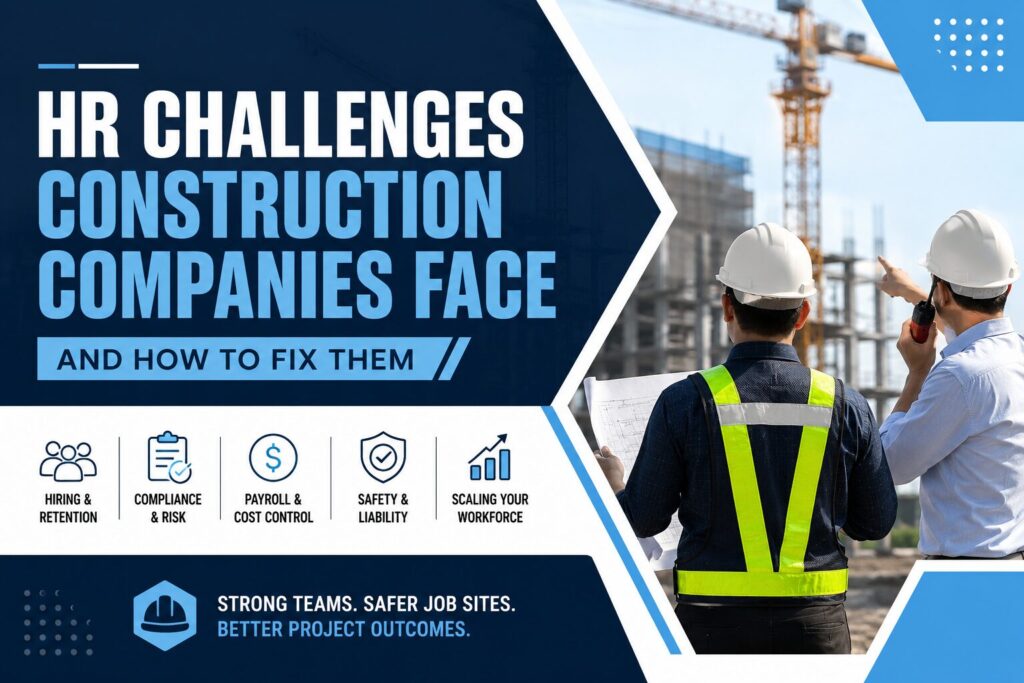
The construction industry has never been an easy business to manage. Tight deadlines, labor shortages, rising insurance costs, compliance pressure, and unpredictable project timelines make daily operations difficult enough. Add workforce management into the mix and many construction business owners find themselves overwhelmed.
Most contractors focus heavily on equipment, materials, bids, and production. Very few realize that the real issue slowing growth often sits behind the scenes in hiring, payroll, compliance, retention, and workforce structure.
Over the years, many construction companies have lost money not because they lacked work, but because they lacked proper HR systems.
The reality is simple. A construction company can survive bad weather. It can survive slow seasons. What becomes difficult to survive is poor workforce management.
Here are the biggest HR challenges construction companies face today and practical ways to fix them before they become expensive problems.
1. Labor Shortages Are Slowing Down Projects
One of the biggest problems construction companies face today is finding reliable workers. Skilled labor has become harder to find while project demand continues to grow.
Many contractors are competing for the same electricians, plumbers, operators, framers, and project managers. Smaller companies especially struggle because they often cannot offer the same benefits or stability larger firms provide.
The result is delayed projects, exhausted crews, rushed hiring decisions, and declining work quality.
How to Fix It
Construction companies need to stop relying only on word-of-mouth hiring. A structured recruiting process matters now more than ever.
Businesses should:
- Build relationships with trade schools
- Offer referral incentives
- Improve onboarding processes
- Create retention plans for top workers
- Offer competitive benefits packages
- Use workforce planning instead of last-minute hiring
Many companies are also turning to PEOs to access better employee benefits and recruiting support without carrying the full administrative burden internally.
Workers stay where they feel valued, protected, and financially secure.
2. Employee Turnover Is Costing More Than Most Owners Realize
High turnover has become normal in construction, but that does not make it harmless.
Every time an employee leaves, the company loses productivity, project consistency, training time, and money. Replacing skilled workers takes time and often slows down active projects.
Some construction companies lose employees simply because communication is poor. Others lose workers because payroll issues, inconsistent scheduling, or lack of benefits create frustration.
How to Fix It
Retention starts long before employees think about leaving.
Construction companies should focus on:
- Consistent communication from leadership
- Clear expectations on job sites
- Accurate payroll processing
- Career development opportunities
- Safety-focused work environments
- Reliable scheduling practices
Employees are more likely to stay when they trust the company running the project.
One overlooked factor is benefits access. Smaller contractors often assume healthcare and retirement plans are out of reach, but PEO partnerships can help provide large-group benefit options that smaller businesses normally cannot access on their own.
3. Payroll Mistakes Create Serious Problems
Construction payroll is rarely straightforward.
Different pay rates, overtime calculations, prevailing wages, union requirements, multi-state workers, and certified payroll reporting all create room for costly errors.
One payroll mistake can quickly turn into:
- Employee disputes
- Tax penalties
- Compliance violations
- Damaged trust
- Delayed projects
Many construction business owners still manage payroll manually or use systems not designed for construction environments.
How to Fix It
Construction payroll requires specialized systems and processes.
Businesses should:
- Automate time tracking
- Separate job costing correctly
- Use certified payroll tools when needed
- Conduct payroll audits regularly
- Ensure overtime laws are properly followed
- Work with payroll specialists familiar with construction regulations
The goal is not simply paying workers. The goal is accurate reporting, compliance, and labor cost visibility.
When labor costs are tracked properly, businesses can protect profit margins and make smarter project decisions.
4. Compliance Issues Are Becoming More Expensive
Construction companies face constant compliance pressure from multiple directions.
This includes:
- OSHA regulations
- Wage and hour laws
- Workers’ compensation requirements
- Employee classification laws
- State labor laws
- Safety documentation requirements
Many businesses do not realize they have compliance problems until an audit, lawsuit, or injury occurs.
Misclassifying workers alone can create massive penalties for construction companies.
How to Fix It
Construction businesses need proactive compliance systems instead of reactive fixes.
That includes:
- Regular HR audits
- Updated employee handbooks
- Proper worker classification reviews
- Safety training documentation
- Payroll compliance checks
- Consistent recordkeeping practices
A strong HR structure protects the business before problems happen.
Many growing construction companies use PEO support specifically because compliance management becomes too complex to handle internally while also managing active projects.
5. Safety Problems Hurt More Than Reputation
Construction remains one of the highest-risk industries for workplace injuries.
Accidents affect more than insurance claims. They impact morale, productivity, scheduling, and company reputation.
Poor safety practices also increase workers’ compensation costs over time.
Some companies unintentionally create unsafe environments by rushing projects, failing to document training, or ignoring smaller violations until larger incidents occur.
How to Fix It
Safety has to become part of company culture, not just a checklist.
Construction companies should:
- Hold regular safety meetings
- Document all training sessions
- Enforce site safety rules consistently
- Conduct equipment inspections regularly
- Encourage employees to report concerns
- Create accountability at every leadership level
Companies with strong safety cultures often see lower turnover, fewer claims, and stronger project performance overall.
6. Communication Breakdowns Damage Productivity
Construction projects move quickly. When communication fails, mistakes multiply.
Many HR problems in construction come from confusion around:
- Scheduling
- Expectations
- Safety procedures
- Payroll timing
- Project responsibilities
- Crew coordination
Field workers and office teams often operate separately, which creates disconnects that eventually hurt operations.
How to Fix It
Better communication systems create stronger projects.
Construction businesses should:
- Use centralized communication tools
- Hold regular project check-ins
- Create clear reporting structures
- Train supervisors on leadership communication
- Keep employees informed about company updates
Strong communication reduces conflict and improves accountability across teams.
7. Small Construction Companies Struggle to Scale
Many construction businesses hit a growth ceiling because operational systems never evolve.
What works for a five-person crew often fails completely at twenty employees.
As businesses grow, owners suddenly face:
- HR administration overload
- Complex payroll processing
- Increased liability exposure
- Benefits management issues
- Hiring pressure
- Compliance responsibilities
Without systems in place, growth becomes chaotic.
How to Fix It
Scaling requires operational structure.
Construction companies should invest early in:
- HR processes
- Payroll systems
- Compliance management
- Workforce planning
- Employee retention strategies
- Leadership development
This is why many growing contractors partner with PEO providers. It allows them to access HR infrastructure, payroll support, benefits administration, and compliance guidance without building massive internal departments immediately.
The right operational support allows construction owners to focus on growth instead of constantly managing administrative problems.
Final Thoughts
Construction companies deal with enough uncertainty already. Workforce problems should not become another preventable obstacle.
The strongest construction businesses are no longer relying on outdated systems, rushed hiring, or reactive management styles. They are building structured operations that support long-term growth.
HR is no longer just paperwork. It directly affects profitability, project timelines, employee retention, safety performance, and business stability.
Companies that take workforce management seriously position themselves to scale faster, protect margins, and compete more effectively in an increasingly demanding industry.
The businesses that win over the next decade will not simply be the ones with the most projects. They will be the ones with the strongest people systems behind those projects.
References
- Occupational Safety and Health Administration (OSHA)
https://www.osha.gov/construction - U.S. Department of Labor Wage and Hour Division
https://www.dol.gov/agencies/whd - National Association of Home Builders Labor Shortage Report
https://www.nahb.org - Associated General Contractors of America Workforce Data
https://www.agc.org - Society for Human Resource Management (SHRM)
https://www.shrm.org - National Federation of Independent Business HR Resources
https://www.nfib.com - Internal Revenue Service Worker Classification Guidelines
https://www.irs.gov/newsroom/understanding-employee-vs-contractor-designation - Construction Industry Institute Safety Research
https://www.construction-institute.org