
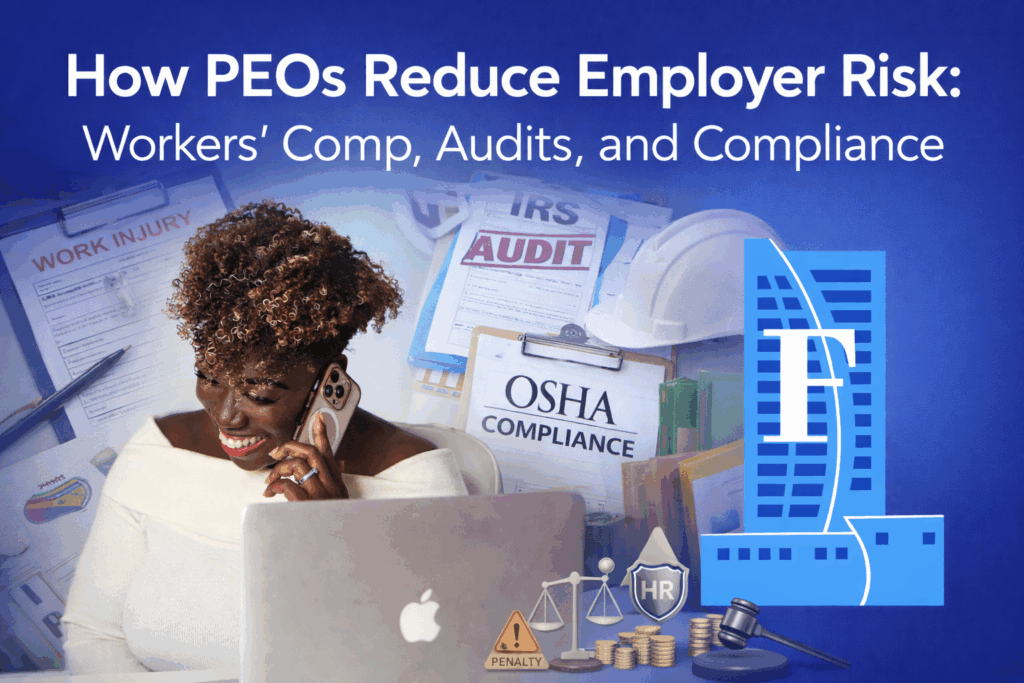
A Small Business Story
A few years ago, Jenna opened a small landscaping business with three employees. Early on, one of her crew slipped on a wet surface and suffered a sprained ankle. What should have been a manageable workers’ compensation claim turned into a maze of paperwork, delayed filings, and unexpected premium increases. Jenna struggled to keep up with updated labor laws, payroll tax filings, and compliance deadlines, all while trying to grow her business.
Then she partnered with a Professional Employer Organization (PEO). The administrative burden lifted quickly. Payroll, workers’ comp claims, tax filings, and compliance oversight were handled by experts. Instead of worrying about audits and penalties, Jenna was able to focus on her crews, scheduling, and client relationships, with more confidence that her risk was being managed correctly.
1. WHAT A PEO IS AND WHY IT REDUCES EMPLOYER RISK
A Professional Employer Organization (PEO) enters a co-employment relationship with a business. In this structure, the PEO shares many employment-related responsibilities such as payroll, benefits, workers’ compensation, and compliance. Unlike traditional HR outsourcing, a PEO becomes the employer of record for administrative purposes, while the client company maintains control over daily operations and employee work.
This matters because the PEO has dedicated teams focused on HR, compliance, and risk management. That expertise helps prevent costly errors that many small businesses unintentionally make.
2. HOW PEOS MANAGE WORKERS’ COMPENSATION AND CLAIMS
Workers’ compensation is one of the most volatile cost centers for many businesses. Premiums can increase quickly after a claim, or when classifications, payroll reporting, and audits are not handled correctly.
Many PEOs provide workers’ compensation coverage through a master policy structure, which can help businesses access stronger coverage management, group buying power, and consistent claims support.
In addition to coverage, a PEO often handles:
Claims reporting and claim coordination
Return-to-work processes
Safety guidance and loss prevention
Audit support and payroll reporting accuracy
This reduces both financial exposure and administrative pressure for the business owner.
3. PAYROLL, TAX FILINGS, AND COMPLIANCE SUPPORT
Compliance is one of the biggest reasons business owners choose a PEO. It is not just about paying employees on time. It is about meeting legal obligations consistently and correctly.
PEOs typically support:
Payroll processing and payroll reporting
Payroll tax calculations and filings
Employee classification support
Documentation and recordkeeping for audits
Ongoing compliance tracking for changing regulations
This reduces the risk of tax penalties, wage and hour issues, misclassification problems, and gaps in required documentation.
4. SAFETY, TRAINING, AND RISK PREVENTION PROGRAMS
PEO risk support often goes beyond paperwork. Many PEOs provide structured safety programs that help reduce workplace incidents before they happen.
Depending on the industry, this can include:
Safety training resources
Workplace risk assessments
Incident reporting systems
Corrective action plans
Return-to-work planning
Reducing incidents is not only good for employee wellbeing. It also helps stabilize workers’ comp costs and can reduce future premium volatility.
5. WHY THIS MATTERS FOR GROWTH-STAGE BUSINESSES
For growth-stage companies, the risk is not only financial. It is operational. When owners and leadership teams are buried in claims, payroll corrections, and compliance tasks, it pulls attention away from growth and client delivery.
A PEO helps by creating a consistent back-office system that can scale with the business. This becomes even more important for companies operating across multiple states, where each state has different rules and compliance requirements.
CONCLUSION
Managing workers’ compensation, payroll compliance, and HR risk without expert support can become overwhelming fast. It also exposes a business to penalties, audit issues, and unnecessary workers’ comp costs.
A PEO partnership helps reduce employer risk by strengthening compliance processes, supporting claims management, improving safety planning, and ensuring documentation is handled correctly. For many businesses, it is not just an administrative decision. It is a strategic move that protects the company and the team behind it.
If you would like to explore whether a PEO is the right fit for your business, Fortune Business Consulting can help you evaluate options and find a structure that matches your goals.
REFERENCES
Worketto: Effective PEO Risk Management
https://worketto.com/peo-risk-management
Elevation HR: How PEOs Manage Workers’ Compensation and Risk
Business Administrative Consultants: How a PEO Reduces Workers’ Compensation Costs and Risk
https://www.businessadministrativeconsultants.com/blog/how-a-peo-reduces-workers-compensation-costs-and-risk
HRMorning: PEO Guide for HR
EmployBorderless: PEO Compliance
https://employborderless.com/peo/services/compliance
Paychex: PEO and Workers’ Compensation
https://www.paychex.com/articles/human-resources/peo-and-workers-compensation
Wikipedia: Professional Employer Organization
https://en.wikipedia.org/wiki/Professional_employer_organization