Introduction
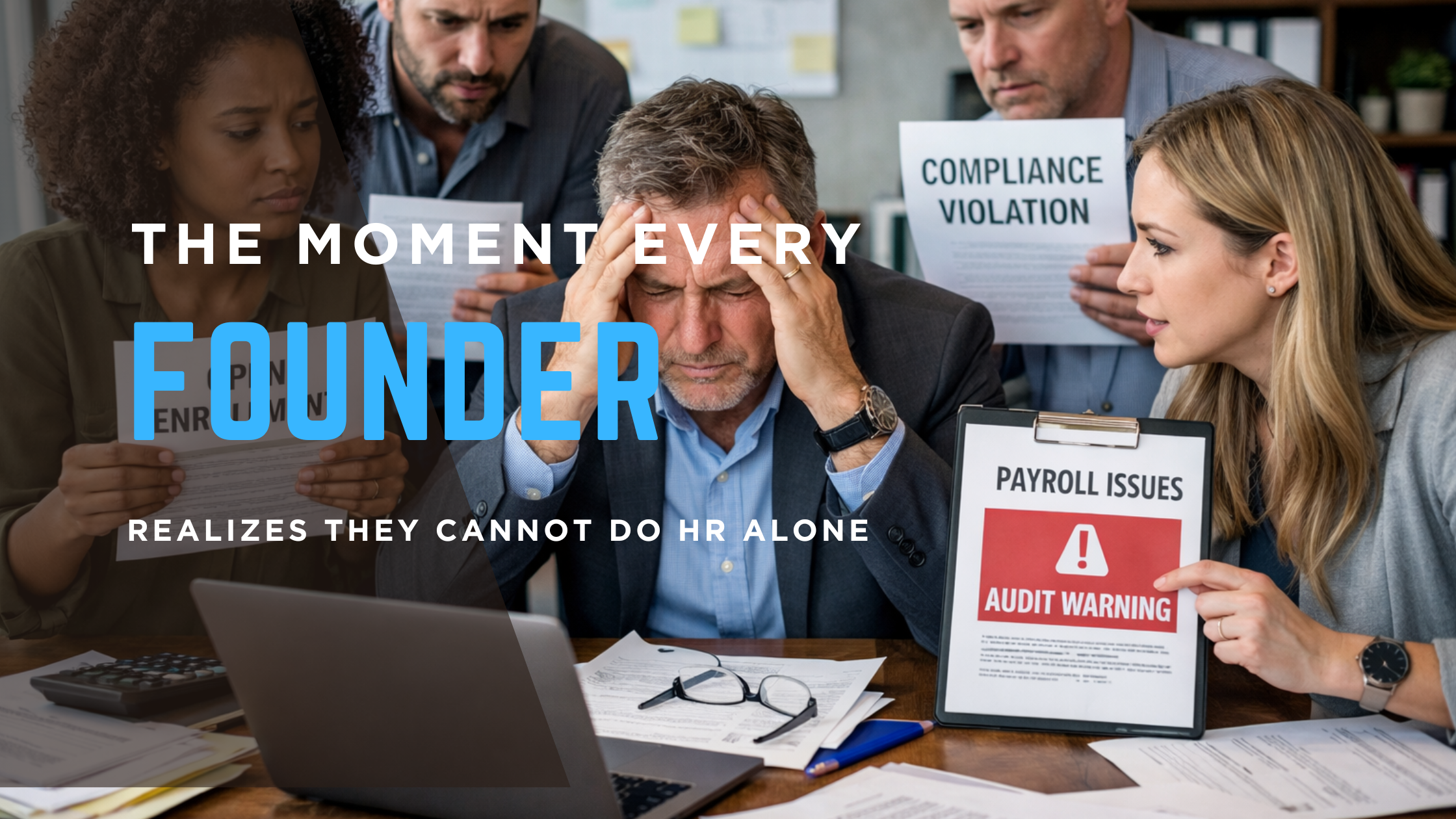
There is a moment almost every founder experience, though few talk about it openly.
It is not dramatic.
It does not happen in meetings.
It rarely comes with a clear warning.
It is the moment HR stops feeling like tasks and starts feeling like weight.
This article explores that moment, why it happens, and why it has nothing to do with effort or capability.
How HR Starts Out Feeling Manageable
In the early days, HR feels simple:
- You hire people you trust
- Payroll runs on basic software
- Benefits are minimal
- Compliance feels distant
At this stage, founders wear every hat. HR is just another responsibility.
For a while, this worked.
The Shift No One Prepares You For
As the business grows, HR quietly changes shape.
One employee becomes:
- Policies
- Documentation
- Classification decisions
- One payroll run becomes:
- Tax filings
- Wage compliance
- Reporting obligations
- One workers’ compensation policy becomes:
- Risk management
- Claims processes
- Safety considerations
HR stops being administrative and starts being structural.
The Emotional Side of HR Overload
Founders rarely say, “HR is overwhelming me.”
Instead, they say:
- “I feel behind all the time.”
- “I hope we are doing this right.”
- “I will deal with it later.”
- “I do not have time to learn this.”
This is not an avoidance. It is overloaded.
The pressure comes from knowing mistakes have consequences, legal, financial, and human.
Why More Effort Stops Working
At a certain point, working harder does not solve HR problems.
No founder is expected to master:
- Employment law
- Payroll tax regulations
- Workers’ compensation rules
- Benefits administration
- Employee relations
Trying to do all of this alone creates risk, not resilience.
Systems, not effort, support growth.
The Quiet Realization
The realization is not “I am bad at HR.”
It is “I should not have to be an HR expert to run my business.”
That is the turning point. The moment founders begin looking for support, not because they are failing, but because the business is succeeding.
What Happens When Support Replaces Strain
When HR systems are put in place:
- Decisions become clearer
- Risk becomes manageable
- Employees feel supported
- Leadership regains focus
This is often when businesses shift from survival mode to intentional growth.
Conclusion
Every founder reaches a point where HR can no longer be handled alone. That moment is not a weakness. It is a milestone.
Recognizing it early protects the business, the team, and the people leading it.
Growth demands structure. Structure allows businesses to scale without burning out the people building them.
References
U.S. Small Business Administration – Managing Employees
U.S. Department of Labor – Employer Compliance Assistance
National Association of Professional Employer Organizations